60-second fit checker
First: look at the part you press from the side. Is it round and domed all over, with no step or ledge anywhere underneath?
Then: measure across the narrow way, at its widest. A ruler will do, or print the gauge below.
Round, or flat?
Look at it from the side. Round all over — Dome, and you are finished. Flat, with a step underneath — step 2.
Measure across the narrow way
At its widest. 16.6 to 20.6 mm is Standard, 21.7 to 25.3 mm is Wide. Outside those two we do not sell a stock size, and we will say so. A ruler does it, or print the free gauge.
Choose it when you order
Every PALM carries the choice. A twin or a trio can be three different ones, because the kitchen and the bathroom rarely match.
The three shapes
Standard and Wide are the same part at two sizes, for flat tops. Dome is a different mechanism, for tops with no step to hook under.
 Standard
16.6 to 20.6 mm across the narrow way. Lever arms, paddles and narrow saddles — most kitchen hand wash and washing‑up bottles.
arrives marked handl S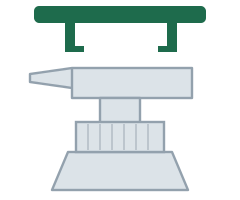 Wide
Wide
21.7 to 25.3 mm across the narrow way. Broad saddles and wide platforms — often shampoo, conditioner and lotion.
arrives marked handl W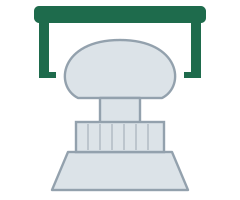 Dome
Dome
Round and domed all over, with no step or ledge underneath. One size. Common on decorative and refillable dispensers.
arrives marked handl DThe bands we sell against, and the strip between them
We named these by size rather than by shape on purpose. In our own testing a lever usually took the smaller part and a saddle the larger one — but that is a habit of the market, not a rule. Narrow saddles and wide levers both exist, and a part called “Saddle” that mostly goes on levers would send people the wrong thing.
Print the free sizing guide
One A4 sheet. Print it at 100%, check the calibration bar really measures 100 mm with any ruler, then lay your pump top on the scale and read off the band. If your printer has scaled the page the bar will show it, so the gauge cannot quietly give you the wrong answer.
Will it fit a Carex, a Method, a Dove?
The honest answer is different for each, and for most brands it is “we have not measured that one”. Both answers are below, because a fit guide that quietly leaves out the ones it does not know is worse than a short one.
Measured — a part has actually been on this bottle
Top is the shape of the part you press. A lever is a long narrow arm you press at one end; a saddle is a broad flat top you press with a flat thumb. That tells you what you are holding, not which part you need — narrow saddles and wide levers both exist — so measure across the narrow way before you choose.
| Brand | Range | Top | You need |
|---|---|---|---|
| Baylis & Harding | Signature | lever | Standard |
| Carex | Aloe Vera Caring Antibacterial Hand Wash, 500 ml | lever | Standard |
| Same name on the label, different parts. Two Carex Original Antibacterial Hand Wash bottles are on this list and they do not take the same one. Which of them you own decides it, so read the description against the bottle in your hand before you choose. | |||
| Carex | Original Antibacterial Hand Wash, small / standard bottle The ordinary supermarket size, not the large wide bottle. | not recorded | Standard |
| Carex | Original Antibacterial Hand Wash, approx. 500 ml Large wide flat-oval bottle, blue liquid. Distinctly wider across the front than the Aloe Vera Caring bottle of the same nominal size. | saddle | Wide Standard would not go on. Wide is what this bottle needs. |
| CeraVe | Hydrating Foaming Oil Cleanser, 236 ml / 8 fl oz Green pump head. | not recorded | Standard |
| Cowshed | hand lotion Tall black bottle with a dark grey / pewter pump head. | not recorded | None of the three Will seat if pushed firmly, and wobbles once on. Recorded as a no: anyone who needs PALM cannot push it on. Wide has not been tried on this bottle, so nothing is claimed about it either way. |
| Cussons | hand wash, honey and bee label | saddle | Wide |
| Decorative dispensers | Chrome The kind you decant into, rather than one that came with soap in it. | dome | Dome |
| Decorative dispensers | Matt black The kind you decant into, rather than one that came with soap in it. | dome | Dome |
Aldi and Lidl own-brand — tried, and the head is what decides it. The narrow ones took Standard and the wide ones took Wide, in both brands, so there is no single answer to print against the name — measure across the narrow way as below.
Not measured — and we will not guess
Astonish · Baylis & Harding Royale Garden · Boots Everyday · Carex ranges other than those above · Dettol · Dove · Imperial Leather · Method · Molton Brown · Natural Collection · Original Source · Palmolive · Radox · Simple · Supermarket own-brand (Tesco, Sainsbury’s, Asda, Morrisons, Wilko)
What “not measured” means, precisely. Nobody publishes the width of a soap pump head — not the brands, not the packaging suppliers. The numbers you can find online, like 24/410 or 28/410, are the neck finish: the diameter of the bottle’s threaded opening and the thread style. That is where the pump screws on, not the size of the part you press, and the same neck carries lever, saddle and dome heads alike. A fitting worked out from a neck size would look researched and be wrong about as often as it was right, so there are none here.
You can answer it yourself in about thirty seconds, on any bottle, including one still on the shelf in the shop. Look at the top from the side. Rounded all over with no step or ledge underneath it — that is Dome. Flat, with something to push — measure across the narrow way at its widest: 16.6 mm to 20.6 mm is Standard and 21.7 mm to 25.3 mm is Wide. A ruler does it, or the free printable gauge does it. The two bands do not meet: a top between 20.6 mm and 21.7 mm falls outside both of the bands we sell against, and so does one narrower than 16.6 mm or wider than 25.3 mm. Those, and oval tops, are the ones to have made to measure, or to send a photograph of before you buy anything.
Or send a photograph of the pump from the side to [email protected] with a 2p coin beside it for scale, and you will get a straight answer, including “none of them fit”. If a measured guess turns out wrong, the exchange is free.
The list above is kept up to date from what customers tell us. A bottle PALM did not fit is worth as much here as one it did — more, because it stops somebody buying the wrong thing. Tell me how yours went and I will add it. If the kitchen pump and the bathroom pump are different shapes, the twin pack takes a different fitting for each, and the trio covers a third.
Between two sizes, or nothing like these?
Between Standard and Wide there is a strip, 20.6 to 21.7 mm, that we do not sell either stock size for. A top that size would seat further from the middle of the slot than we are prepared to sell on without having measured it on a real pump. Made to measure is the answer for that one, printed to your own pump. If it looks like none of the three, or it is oval, the same goes: don't guess.
And if the size turns out wrong, I will exchange it free. So a measurement you are not quite certain of is still worth acting on: the worst case is a padded envelope, not a wasted £9.99. It is not a reason to pick between the two sizes and hope, though — between 20.6 and 21.7 mm you are outside the band we sell either of them against, so an exchange there only swaps one guess for another. That is the one to ask about first.
Before you measure — is a clip-on the right answer at all?
Getting the size right is no use if the object is wrong for you. It solves one problem: you can still press something, but not with a fingertip.
If pressing is impossible rather than painful, this is the wrong thing to buy. There is no lever in it and no pivot, so the pump stays exactly as stiff as it was — if it is the force that beats you rather than where it lands, one of the other five options is the better buy. And if you cannot use your hands at all, something still has to press the disc. I would rather say that here than take your money. The full list of who PALM is not for, and all six options compared, including the two where somebody else's is the better buy.
Fit, use and care
Fitting Standard and Wide — spout first: hold PALM level, put the wide opening of the slot over the spout end of the pump head, then slide PALM back along the head until it grips. It goes on sideways, not down from above. Starting at the back of the head is the wrong way round and will not seat — if it feels like it does not fit, try it from the other end before anything else. To take it off, slide it back out the same way.

Fitting Dome — straight down, one full press: the Dome does not slide on. Place PALM over the rounded head, then press it all the way down until soap comes through the spout. That one full press is what seats it — a Dome pushed on lightly will sit loose and rock. To take it off, pull it straight up.
None of it should be a fight. If it needs real force, it is the wrong size — check the measurement rather than pushing harder, and we will exchange it free.
Use: place your palm, fist or forearm near the centre and press straight down. Keep the pump spout clear.
Moving it, and taking it with you: it comes off as easily as it went on, so it moves between bottles that take the same size — the kitchen one, the bathroom one, and whatever is on the basin somewhere else. It is a disc, so it goes in a pocket or a wash bag: the gym, a friend's house, a public bathroom. That is the part nothing else here can do: a wall dispenser is screwed to the wall, and an electric one is a unit with a tank in it, so both stay on the shelf you put them on. What you cannot know in advance is what pump is at the other end — if it is outside the sizes above, the disc in your pocket will not fit it.
Clean: hand wash in warm water. Do not use hot water and do not put it in the dishwasher — the material softens above 60 °C. Rinse under the tap or wipe with a damp cloth, then let it dry.
Material: printed in Bambu Lab PLA Pure, white — a plant-based filament whose five ingredients are each certified against the EU food-contact standard (EU 10/2011) and EN 71-3 toy safety. Certified ingredients are not the same as a certified part: printed parts have layer lines that hold moisture and soap, so we do not describe PALM as food safe. When it finally wears out, the part is recyclable industrially, not through household collection, where it contaminates the plastics stream.
Packaging: the mailer is certified home compostable to EN 13432, TÜV OK compost HOME, licence S1362. The wrap, band and labels are paper and recyclable. There is no plastic in the packaging.
PALM is a daily-living aid, not a medical device. If a bottle is unstable, place it on a level, non-slip surface before use.